
Mastering Wealth in 2026: Top AI Strategies & Tools for Savvy Investors
The financial landscape has shifted. In 2026, the “buy and hold” mantra of the past has been replaced by “analyze and adapt.” With the explosion of generative AI and predictive modeling, individual investors now have access to tools that were once reserved for institutional hedge funds. To stay ahead, you must understand how to leverage these technologies to protect and grow your capital.
1. The AI Revolution in Finance: Beyond Simple Automation
While automation has been around for decades, AI-driven finance represents a leap into cognitive computing. Today’s systems don’t just follow rules; they learn from market anomalies.
Predictive Analytics and Market Sentiment
Modern AI tools now analyze “alternative data”—everything from satellite imagery of retail parking lots to real-time shipping manifests—to predict company earnings before they are even announced. For the savvy investor, this means moving from reactive trading to proactive positioning.
The Death of the Traditional Spreadsheet
We are seeing a move away from static financial modeling. AI now allows for “Monte Carlo simulations” that run millions of scenarios in seconds, helping you understand exactly how a global geopolitical event might impact your specific portfolio.
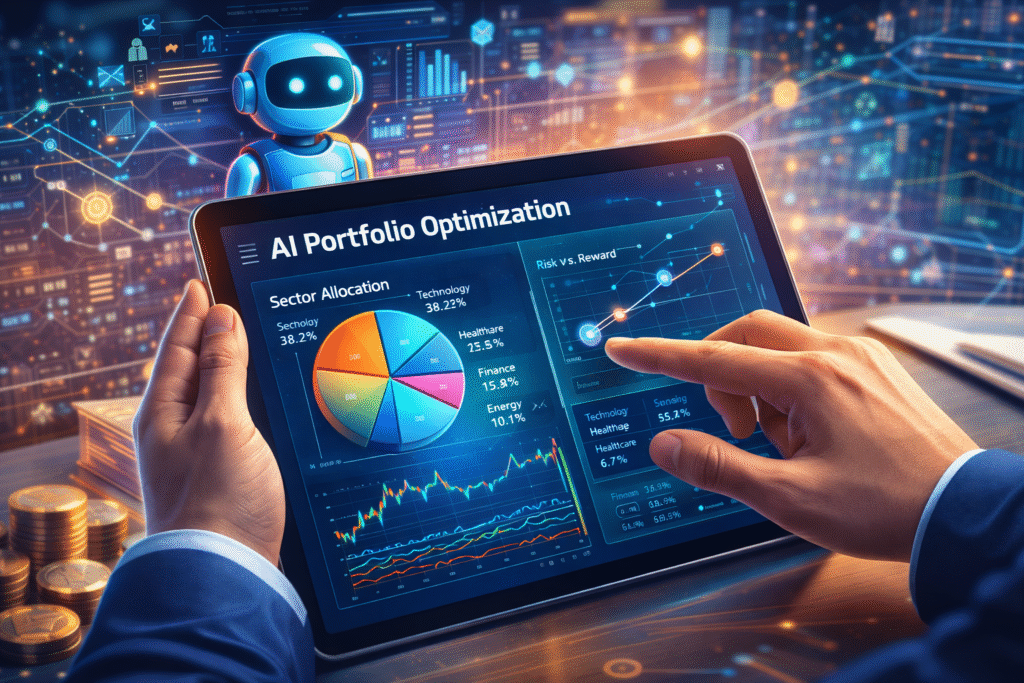
2. Top AI Tools for Portfolio Optimization
Choosing the right Fintech platform is the difference between mediocre returns and market-beating performance.
Next-Gen Robo-Advisors
Unlike the basic robo-advisors of the 2010s, 2026’s AI advisors use Natural Language Processing (NLP) to understand your life goals. If you tell your app, “I want to buy a house in three years but I’m worried about inflation,” the AI adjusts your asset allocation across stocks, bonds, and tokenized real estate instantly.
Real-Time Tax-Loss Harvesting
One of the most “expensive” clicks in the insurance and finance world is Tax Optimization. AI now tracks your wins and losses daily, automatically selling underperforming assets to offset capital gains taxes, potentially saving investors thousands of dollars annually without manual intervention.
3. Advanced Risk Management: Protecting Your Capital
In a volatile market, what you don’t lose is as important as what you gain.
Volatility Forecasting
Using Deep Learning models, investors can now receive alerts when market conditions mirror previous crashes. These “early warning systems” allow you to hedge your positions using options or moving to liquid assets before the “herd” reacts.
Fraud Detection and Cybersecurity
As financial scams become more sophisticated, AI-integrated wallets and brokerage accounts use Biometric Behavioral Analysis. They recognize if a transaction “doesn’t feel like you,” providing a layer of security that traditional passwords simply cannot match.
4. The Ethical Horizon: AI and the Future of Wealth
As we lean more on algorithms, the human element remains vital.
Avoiding “Algorithm Bias”
Savvy investors must ensure their AI tools are transparent. Understanding why an AI suggests a specific stock is crucial for long-term trust. 2026 is the year of Explainable AI (XAI) in finance—where the “black box” is finally opened.
The Hybrid Approach
The most successful investors in 2026 use a “Centaur” model: AI handles the data crunching and execution speed, while the human provides the ethical oversight and long-term vision.
The Emergence of AI in Alternative Assets
Beyond traditional stocks and bonds, 2026 has seen a surge in AI tools specifically designed for alternative investments. From Predictive Real Estate Analytics that forecast neighborhood appreciation to AI-driven Crypto Sentiment bots, the scope of “wealth” is expanding. These specialized tools allow investors to diversify into high-growth areas with the same level of data-backed confidence usually reserved for the S&P 500. By integrating these alternative AI signals, you create a truly “all-weather” portfolio capable of thriving in any economic climate.
Conclusion: Your AI Financial Roadmap
The barrier to entry for high-level wealth management has collapsed. By integrating AI tools for predictive analysis, tax optimization, and risk management, you aren’t just investing; you are engineering your financial future.













Post Comment